Can a Power Station Run a Microwave? Model Data
Can a power station run a microwave? Yes, if its inverter beats the oven's input watts. See which models start one and how many minutes each charge cooks.
Amphourly is reader-supported. When you buy through links on this page we may earn an affiliate commission, at no extra cost to you. Rankings come from our published scoring method, not from who pays. How we make money
Yes, a power station can run a microwave if its continuous AC output is higher than the oven’s input draw. A full-size microwave pulls about 1,500 W, so you need a 1,500 W+ inverter, which among the stations we track means a 1kWh-class station or bigger. A 1kWh unit like the EcoFlow DELTA 3 Plus cooks for about 35 minutes per charge.
That’s the short answer. The rest of this page shows which of the 39 stations in our database pass, how many minutes each one actually cooks, and why the number printed on your microwave’s box is the wrong one to size against.
How many watts does a microwave really use?
More than the box says. Our appliance wattage table uses two reference values:
| Microwave | Input draw we use | Source |
|---|---|---|
| Full-size (1.25 cu ft) | 1,500 W | EWEB appliance cost table |
| Compact | 925 W (midpoint of 750–1,100 W) | EPA typical-wattage list |
Those are input watts, the power the oven takes from the outlet. The cooking power on the front of the box is lower because the magnetron, fan, turntable motor and light all lose energy along the way. Your power station’s inverter has to supply the input figure, not the cooking figure.
Which power stations can run a microwave?
Here’s how the 39 stations we track split, using the same pass/fail test as our runtime calculator: the appliance’s running watts must fit the inverter’s continuous rating.
| Result | Stations | What decides it |
|---|---|---|
| Runs a full-size 1,500 W oven | 29 models, every one from 998 Wh up | Continuous output of 1,500 W or more |
| Runs a 925 W compact only | DJI Power 500 (1,000 W), BLUETTI AC70 (1,000 W), Anker SOLIX C800 Plus (1,200 W) | 925–1,499 W inverters |
| Runs neither | 7 models under 600 Wh, from the EcoFlow RIVER 3 to the OUPES Exodus 700 | 300–700 W inverters |
The five stations below span that range, from a 512 Wh unit that only handles a compact oven to a 2kWh unit that cooks for over an hour.
| Station | Capacity | Continuous / surge | Full-size (1,500 W) | Compact (925 W) |
|---|---|---|---|---|
| DJI Power 500 | 512 Wh | 1,000 W / not published | Over inverter | 28 min |
| BLUETTI Elite 100 V2 | 1,024 Wh | 1,800 / 3,600 W | 35 min | 56 min |
| EcoFlow DELTA 3 Plus | 1,024 Wh | 1,800 / 3,600 W | 35 min | 56 min |
| Jackery Explorer 1000 Plus | 1,264 Wh | 2,000 / 4,000 W | 43 min | 70 min |
| Anker SOLIX F2000 | 2,048 Wh | 2,400 / 3,600 W | 70 min | 113 min |
The small station fails on running watts, not capacity. The DJI Power 500 has 435 Wh of usable energy, enough for 17 minutes of a full-size oven, but its 1,000 W inverter shuts off before the oven gets going. Here’s how the computed tables look for three of them:
| Appliance | Draw | Inverter | Runtime | Runtime as a share of 24 hours |
|---|---|---|---|---|
| Microwave oven (1.25 cu ft) | 1,500 W | Over inverter | — | |
| Microwave oven (compact) | 925 W | Runs | 28 min |
Runtime = usable energy ÷ average draw. We count 85% of the rated 512 Wh as usable (435 Wh) to cover inverter and DC conversion losses. Fridges and freezers are averaged over their compressor cycle. An appliance runs only if its running watts fit the 1,000 W inverter and its start-up surge fits the 1,000 W surge rating. Wattages come from our appliance wattage table; try your own mix in the runtime calculator.
| Appliance | Draw | Inverter | Runtime | Runtime as a share of 24 hours |
|---|---|---|---|---|
| Microwave oven (1.25 cu ft) | 1,500 W | Runs | 35 min | |
| Microwave oven (compact) | 925 W | Runs | 56 min |
Runtime = usable energy ÷ average draw. We count 85% of the rated 1,024 Wh as usable (870 Wh) to cover inverter and DC conversion losses. Fridges and freezers are averaged over their compressor cycle. An appliance runs only if its running watts fit the 1,800 W inverter and its start-up surge fits the 3,600 W surge rating. Wattages come from our appliance wattage table; try your own mix in the runtime calculator.
| Appliance | Draw | Inverter | Runtime | Runtime as a share of 24 hours |
|---|---|---|---|---|
| Microwave oven (1.25 cu ft) | 1,500 W | Runs | 1.2 h | |
| Microwave oven (compact) | 925 W | Runs | 1.9 h |
Runtime = usable energy ÷ average draw. We count 85% of the rated 2,048 Wh as usable (1,741 Wh) to cover inverter and DC conversion losses. Fridges and freezers are averaged over their compressor cycle. An appliance runs only if its running watts fit the 2,400 W inverter and its start-up surge fits the 3,600 W surge rating. Wattages come from our appliance wattage table; try your own mix in the runtime calculator.
How many minutes of cooking do you get per charge?
Runtime is usable energy divided by the draw. We count 85% of rated capacity as usable to cover inverter losses (the runtime formula guide explains why), so a 1,024 Wh station has about 870 Wh to spend.
- Full-size oven: 870 Wh ÷ 1,500 W = 0.58 hours, or 35 minutes.
- Compact oven: 870 Wh ÷ 925 W = 0.94 hours, or 56 minutes.
Thirty-five minutes sounds short, but nobody runs a microwave for half an hour. Think in sessions instead. A two-minute reheat on a full-size oven uses 1,500 W × 2/60 h = 50 Wh. That’s about 17 reheats from one charge of a 1kWh station, or 28 on a compact oven, which uses about 31 Wh per two-minute session.
Worked example: a day of outage cooking
Say the power’s out and you’re running a fridge and a microwave from a DELTA 3 Plus. An ENERGY STAR fridge averages 51 W once you account for its compressor cycling, as our fridge runtime data shows, so:
| Load | Math | Energy |
|---|---|---|
| Fridge for 12 hours | 51.2 W × 12 h | 614 Wh |
| Three 3-minute microwave meals | 1,500 W × 9/60 h | 225 Wh |
| Total | 839 Wh |
That just fits the 870 Wh usable. The microwave meals cost about a quarter of the battery, which is why short bursts are fine and long cook cycles aren’t. Plug your own mix into the runtime calculator to see where the line falls for your station.
Compact vs full-size microwaves: which suits a power station better?
A compact oven is the better match for anything under 1kWh. The 925 W reference figure lets the 512 Wh DJI Power 500 and the 768 Wh BLUETTI AC70 or Anker SOLIX C800 Plus run one, and every station gets about 60% more cooking minutes than with a full-size oven.
The catch is that “compact” covers a wide range. The EPA list puts compact microwaves at 750–1,100 W. A 750 W oven runs comfortably on a 1,000 W inverter; a 1,100 W one overloads the DJI Power 500 and AC70. Check your specific oven’s input rating before you count on a small station.
Full-size ovens heat faster per minute, so the gap in actual meals is smaller than the gap in minutes suggests. If you already own one, a 1kWh+ station with an 1,800 W or larger inverter is the easy answer.
Why the label wattage misleads
Microwaves are marketed by cooking power: the “1,000 W” or “1,100 W” on the box is how much microwave energy reaches the food. The input power is higher, and that’s what the station supplies.
To find the real number, look at the rating label inside the door or on the back. It lists either input watts or amps:
- If it says watts, use that figure.
- If it lists amps, multiply by 120 V. A label reading 12.5 A means 12.5 × 120 = 1,500 W input.
This is the most common reason people buy a “1,000 W” station for a “1,000 W” microwave and watch it shut off the moment they press start.
Our appliance table doesn’t list a separate start-up figure for microwaves, so the RuntimeTable checks running watts only (our guide to running watts vs starting watts explains which appliances spike). Leaving 20% or more spare inverter capacity covers the brief spike when the magnetron kicks in and any difference between your oven and the reference value.
Which station should you pick for microwave use?
If a microwave is on your must-run list, start at 1kWh with an 1,800 W inverter. Among the five stations above, the DELTA 3 Plus scores highest on our rubric, thanks to 4,000 rated cycles, a 56-minute wall recharge and 1,000 W of solar input to refill between meals.
| Spec | DJI Power 500 | BLUETTI Elite 100 V2 | 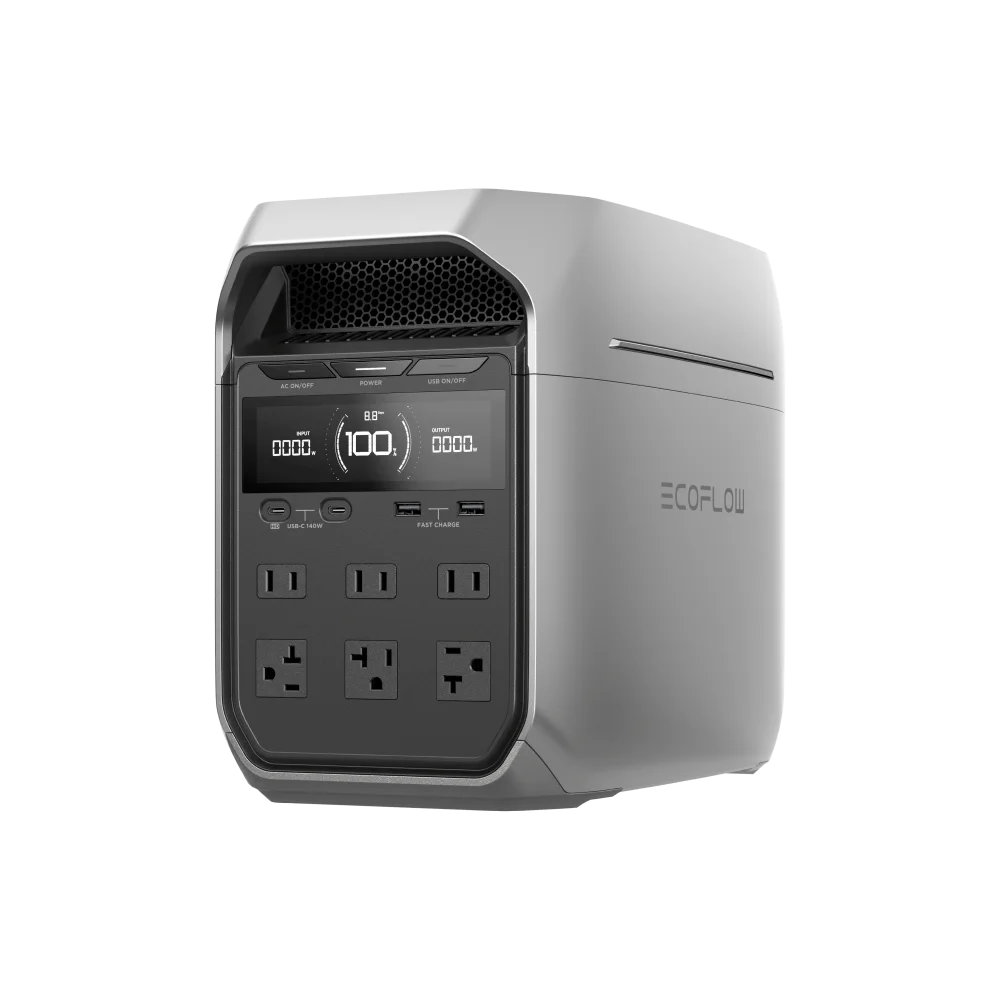 | Jackery Explorer 1000 Plus | Anker SOLIX F2000 |
|---|---|---|---|---|---|
| Score | 6.1 | 8.1 | 9.0 | 6.9 | 7.2 |
| Battery chemistry | LiFePO4 | LiFePO4 | LiFePO4 | LiFePO4 | LiFePO4 |
| Rated cycle life | — | 4,000 | 4,000 | — | 3,000 |
| AC output | 1,000 W | 1,800 W | 1,800 W | 2,000 W | 2,400 W |
| Energy density | 31.8 Wh/lb | 40.96 Wh/lb | 37.1 Wh/lb | 39.5 Wh/lb | 30.48 Wh/lb |
| AC recharge time | 70 min | 70 min | 56 min | — | — |
| Solar recharge rate | 0.59 W per Wh | 0.98 W per Wh | 0.98 W per Wh | 0.63 W per Wh | 0.49 W per Wh |
| Expandable | No | No | Yes | Yes | Yes |
| UPS switchover | 20 ms | 10 ms | 10 ms | 20 ms | 20 ms |
| Warranty | 5 yr | 5 yr | 5 yr | 3 yr | 5 yr |
| App control | none | wifi+bluetooth | wifi+bluetooth | wifi+bluetooth | bluetooth |
| Launch MSRP | $499 | — | — | — | — |
Best for microwave use (top score of the five)
EcoFlow DELTA 3 Plus
- Battery chemistry
- LiFePO4
- Rated cycle life
- 4,000
- AC output
- 1,800 W
- Energy density
- 37.1 Wh/lb
A 1024Wh LiFePO4 power station with an 1800W inverter, dual 500W solar inputs and a 10 ms UPS, suited to home backup, off-grid solar charging and RV use, expandable with extra batteries.
Strengths
- 1000W solar input across two 11-60V ports
- Full AC recharge in 56 minutes at 1500W input
- Two 140W USB-C ports and two 36W USB-A ports
- Expandable up to 5kWh with compatible DELTA extra batteries
Watch out for
- 27.6 lb with no wheels
- Extra batteries connect via an Alternator Charger XT150 Output Cable
- Same 1024Wh capacity as the DELTA 3; the Plus mainly adds solar and USB power
If you cook for a family or want a microwave and a fridge through a full day, the 2,048 Wh Anker SOLIX F2000 doubles the cooking time and its 2,400 W inverter leaves plenty of headroom. For lighter loads with a compact oven, the DJI Power 500 is the smallest station here that runs one. Browse every model by capacity in our power station rankings.
Frequently asked questions
What size power station do I need to run a microwave?
For a full-size microwave, pick a station with at least 1,500 W continuous output; among the stations we track, that means roughly 1,000 Wh and up. A 925 W compact oven runs on smaller units like the DJI Power 500 or Anker SOLIX C800 Plus.
How long can a 1000Wh power station run a microwave?
About 35 minutes of a 1,500 W full-size oven, or 56 minutes of a 925 W compact one, after we take 15% off the rated capacity for inverter losses.
Will a 1000W power station run a 1000W microwave?
Usually not. A microwave sold as 1,000 W is rated by its cooking output, and its input draw is higher, often around 1,500 W for a full-size oven. Check the input watts or amps on the back label.
Do X-Boost or power-lifting modes help with a microwave?
Don't count on it. Those modes are built for resistive heating loads such as kettles and hair dryers. A microwave isn't a simple resistive load, so size the inverter to its real input draw.